- 《鬼地方》、《臺灣漫遊錄》 義大利文譯者翻譯家傅雪蓮專訪:深刻私密的臺灣情感經驗也能存在於義大利文之中 (Interview with Silvia Pozzi, the Italian translator of Ghost Town and Taiwan Travelogue: even the deepest and most intimate Taiwanese emotional experiences can find expression in Italian - May 29th 2026)
Chinese did not give me answers. It gave me better questions.
- 譯者的慧眼與才華、小出版社的冒險膽識,帶著《臺灣漫遊錄》踏上世界漫遊 (The translator's keen insight and talent, combined with the boldness and adventurous spirit of a small independent publisher, have taken Taiwan Travelogue (臺灣漫遊錄) on a journey around the world, 報導者 The Reporter - May 28th 2026)
In the early hours of May 20th, 2026, Taiwan Travelogue (臺灣漫遊錄) by Yang Shuang-zi and its English translation by Jin Ling were awarded the prestigious International Booker Prize. This marks the first time that a work of Taiwanese literature has received the world's most prestigious international award for translated fiction.
The increasing appeal of contemporary Chinese literature [in Italy] lies in its capacity to present forms of thought distinct from the Western tradition, opening up other possibilities for understanding and interpreting modernity.
- “创作者的心必须是热的”——《下午三点》的意大利回响 ("The creator’s heart must be passionate” — The Italian Echo of Three in the Afternoon, 人民日报 People's Daily - February 6th 2026)
What is poetry? It is the breathtaking beauty and heroic spirit that have been recited for centuries in Tang poems and Song lyrics, as well as the simple and heartfelt celebration of life penned by laborers.
- Haiyan, the City of Writer Yu Hua: From His Novels to Discovering the New China (Corriere, December 15th 2025)
Small by Chinese standards but great in literature, Haiyan is the birthplace of the stories of Yu Hua, a representative author of contemporary China. Thanks to translations of his work around the world —and to the efforts of Silvia Pozzi, his Italian voice— the city and his stories have become a cultural bridge between East and West.
- The Poet-Rider Who Wrote Over 6,000 Poems in China (PiùCulture, December 13th 2025)
The story of Wang Jibing and Martina Benigni crossed paths by chance in Shanghai, where Martina was spending a period of study. A PhD student in Asian and African Civilizations at the University of Rome La Sapienza and a Chinese language student for nearly ten years, Martina (known in China as Lin Mingyue) stumbled upon Flying Close to the Ground, one of the five collections published by Wang Jibing, on the shelves of a small university campus bookstore.
- “At Three in the Afternoon”: Wang Jibing’s Poetry Brings China and Italy Closer (Giornale Diplomatico, December 12th 2025)
At the Rome 9 Center for Sino-Italian Economic and Cultural Exchanges, the first Italian screening of the documentary “At Three in the Afternoon: The Global Echo of the Poet-Rider” was held. The film is dedicated to Wang Jibing and to Martina Benigni, the Italian translator of the poem "At Three in the Afternoon" and PhD student in Asian and African Civilizations at the University of Rome La Sapienza.
- 一首中国小诗的跨国旅行 (The Transnational Journey of a Chinese Poem - 中国青年报 China Youth Daily - December 2nd 2025)
"Literature and poetry must always have a place in my life.” This passion was already planted in Martina Benigni’s childhood. After coming to China, poetry became an important window through which she observes and understands social life. Out of love for it, she attempted to translate several poems from Flying Close to the Ground into Italian and sent them to her co-supervisor Silvia Pozzi, professor at the University of Milan-Bicocca.
- Rome, San Lorenzo Hosts the First Italian Screening of “At Three in the Afternoon: The Global Echo of the Poet-Rider”. The Story of Wang Jibing (Il Messaggero - November 19th 2025)
His poem “Alle tre del pomeriggio” was translated into Italian by Martina Benigni, a PhD student in Asian and African Civilizations at the University of Rome La Sapienza, under the supervision of Silvia Pozzi, professor at the University of Milan-Bicocca. Thanks to their work, Italian readers have been able to experience the warmth and vitality of Chinese popular literature.
- "Italian sinologist tells compelling Chinese stories through literary translation" (Chinese Social Sciences Today - August 28th 2025)
The year 2025 marks the 55th anniversary of diplomatic relations between China and Italy, with both sides launching a series of commemorative events. As outstanding representatives of Eastern and Western civilizations, China and Italy demonstrate how storytelling remains one of the most effective forms of cultural exchange. Italian sinologist and translator Silvia Pozzi, recipient of the 17th Special Book Award of China, has translated the works of several Chinese authors and continues to devote herself to translation studies. She believes translation is not about “explaining” China, but about telling the world truly compelling Chinese stories.
- InXinjiang(68)·汉学家说丨30年后再访新疆,傅雪莲眼中的变与不变 / InXinjiang (68)· Insights from Sinologists | A Sinologist's revisit to Xinjiang in 30 years (Tianshannet - August 19th 2025)
Silvia Pozzi, Sinologist and Professor at the University of Milano-Bicocca, first visited Xinjiang 30 years ago. She shared that both the Xinjiang of three decades ago and today have left a profound impression on her. While Xinjiang has developed rapidly and undergone tremendous changes, the warmth of its people remains unchanged.
- 翻译须防“异国情调化”——访意大利翻译家、米兰比可卡大学教授傅雪莲 (Translation must avoid "exoticisms" - Interview with Silvia Pozzi, sinologist and professor at the University of Milan - Bicocca - 中国社会科学报 China Social Sciences Today - August 11th 2025)
In 2025, China and Italy launched a series of commemorative activities to mark the 55th anniversary of the establishment of diplomatic relations between the two countries. China and Italy both represent excellent civilizations, in the Eastern and Western spheres respectively, and stories constitute one of the most effective forms of cultural exchange. In addition to having translated the works of numerous Chinese writers, Italian sinologist and translator Silvia Pozzi, winner of the XVII Special Book Award of China, devotes constant attention to research in the field of translation studies, believing that translation should not serve to "explain" China, but rather to tell the world Chinese stories capable of moving people.
-
文学翻译如何架起中意文化“桥梁”?——专访意大利汉学家、米兰比可卡大学教授傅雪莲 (How can translation build "bridges" between the Chinese and Italian culture? Interview with Silvia Pozzi, sinologist and professor at Milan - Bicocca University - 中国新闻网 Chinanews - July 15th 2025)
Italian Sinologist, literary translator, and professor at University of Milan-Bicocca, Silvia Pozzi speaks fluent Chinese and has a deep understanding of modern and contemporary Chinese writers and literary works. Recently, after traveling thousands of kilometers to China's Xinjiang region to participate in the "World Sinologists Look at China" programme, Silvia Pozzi released an exclusive interview to "East-West Questions" program, for China News, explaining how literary translation builds "bridges" for cultural exchanges between China and Italy.
- 马兴瑞会见“世界汉学家看中国·新疆行”参访团一行 (Ma Xingrui Meets Delegation of Sinologists in Xinjiang for the “Sinologists on China” Program - 新疆广播电视台 Xinjiang Radio and Television - June 27th 2025)
On 26 June, Ma Xingrui, Secretary of the Party Committee of the Xinjiang Uygur Autonomous Region, met with the delegation of the “Global Sinologists on China - Xinjiang Tour” in Urumqi. Ma Xingrui expressed his pleasure at welcoming the sinologists to Xinjiang on behalf of the CPC Xinjiang Uygur Autonomous Regional Committee and the People’s Government of the Autonomous Region. He described the sinologists as ambassadors of cultural exchange and dialogue between China and other countries. Ma highlighted that, since ancient times, Xinjiang has been a region where multiple ethnic groups live together, diverse cultures interact, and different religions coexist. With its long history, rich culture, and unique features, he said, this visit is of great significance for the sinologists in conducting academic research and gaining a deeper understanding of China.
- Silvia Pozzi interviewed by the TVL news program at the Pari e Dispari Festival (TVL, November 23rd 2024, from min. 9:02)
-
第二十四届世界意大利语言文化周|“意大利语与书籍:字里行间的世界” (24th International Week of the Italian Language in the World: “Italian and the Book: A World Between Lines” – October 15th 2024)
On the morning of 15 October 2024, the opening ceremony of the 24th International Week of Italian Language and Culture, themed “Italian Language and Books: A World Between Lines”, was held at the library auditorium of Guangdong University of Foreign Studies. […] The second part of the ceremony featured a lecture by Professor Silvia Pozzi titled “Italian Language and Books: A World Between Lines”. In her lecture, Professor Pozzi explained to the students the differences between Chinese and Italian, as well as the challenges that arise during the translation from Chinese into Italian.
- "The China You Wouldn’t Expect": Meeting with Silvia Pozzi at Lo Spazio (Report, October 3rd 2024)
Saturday, October 5th, at 6:00 PM, at the bookstore Lo Spazio Pistoia (Via Curtatone e Montanara 20/22), “The Unexpected China”: a conversation with Silvia Pozzi, translator and professor of Chinese and Southeast Asian Language and Literature at the University of Milan–Bicocca, in dialogue with Alessandra Repossi, literary translator.
Through three novels and a short story collection -each very different from the others- three Chinese authors (one male, two female) and one Taiwanese author invite us to explore how contemporary China tells its story to the world, revealing the undeniable links between China’s past and the modern global context.
- Literature Reveals the China You Don’t Expect (La Nazione, October 3rd 2024)
There is a world struggling to emerge, still unable to break through the wall of prejudice that sees China only as a regime, China only as an economic threat. And what of the Chinese people? Some say they never even die. To imagine them smiling seems impossible. Serious, reserved, reluctant to integrate. How can Chinese authors -and the works shaped by that world- make their way in such a climate of distance, or worse, suspicion? What a pity. If only it could happen -if those books found their way into our living rooms or slipped under our blankets- we would be utterly overwhelmed, dazzled.
-
傅雪莲:余华在意大利有大批粉丝 ("Fu Xuelian: Yu Hua has a large fan base in Italy" - June 22nd 2024)
Nowadays, the interest in Chinese writers like Liu Cixin and Yu Hua is growing exponentially among Italian readers. Liu Cixin attracted numerous Italian fans of Chinese sci-fi literature; Yu Hua has become a star in Italy: almost all his works, with the exception of a couple of essays about his childhood, have been translated into Italian. His notoriety goes beyond the literary world; he has become a real star.
- The climate change festival opens with two books by Taiwanese writers (March 17th 2024)
A morning of discussion devoted to the topic of translation, with a particular focus on Taiwan. This is the event scheduled for Saturday, 23 March at 10:30 a.m. in the Terzani Auditorium at the San Giorgio Library in Pistoia, as part of the Climate Fiction Days festival, the first national event dedicated to literature on climate change. […] Environmental issues in their broadest cultural dimensions are explored in Mountains and Clouds in the Eyes by Taiwanese writer Wu Ming-yi, translated into Italian by Silvia Pozzi […]. Also featured is Membrana (add, 2022) by Chi Ta-Wei, translated by Alessandra Pezza: a dreamlike novel set in a world dominated by technology, which accompanies the protagonist on an inner journey in search of the essence of what it means to be human.
With her translation of Folding Beijing by Hao Jingfang, Silvia Pozzi brings Italian readers an original and compelling voice from the contemporary Chinese literary scene. (…) Although shaped by a fantastical distortion of the reality we know, the worlds of these stories inevitably reflect our own, and the characters who inhabit them ultimately share our same emotions and ambitions. (...) It is for this reason that their experiences are captivating and resonate with the reader. But there is more: this subtle communication is also made possible by the translator’s mastery, by the flexibility - or rather the “foldability”- of her style: that alchemical skill of tracing and adapting the original text and returning it to us in a new language so that it feels fresh and unexpectedly familiar: fluid, nuanced, and elegant.
- Presentation of the OTP Translation Lab at la Lettura (October 24th 2021) for the publication of the short story Has Anyone Seen the Neighbor? (available at this link)
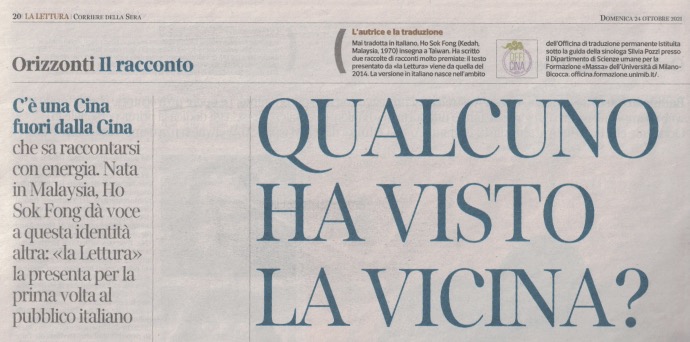
The Author and the Translation
Previously untranslated into Italian, Ho Sok Fong (Kedah, Malaysia, 1970) teaches in Taiwan. She is the author of two award-winning short story collections; the work published in la Lettura is included in the 2014 collection. The Italian translation was produced as part of the OTP Translation Lab, set up under the guidance of the sinologist Silvia Pozzi at the Department of Human Sciences for Education "R. Massa" at the University of Milan-Bicocca.
- "A Permanent Translation Lab", by Silvia Pozzi. Read the full article published in Il Giorno (Milan, Monza and Brianza, Alta Lombardia)
Some people think that translators are, or should be, invisible; perhaps, it is truer to say that we almost never think about them, unless the Italian language of the book strikes us as awkward and convoluted. If we were to step into their world, we would discover that they are more alive than ever.
Videos
- "Silvia Pozzi: The time is ripe for Chinese literature to flourish": Episode of the People's Daily "Our China Stories" programme, featuring Silvia Pozzi and the translation of Chinese literature in Italy.